To get a PDF copy, press Print and choose “Save as PDF”.

FRP Square and Rectangular Tube Technical Data Sheet — GFRP Box Profile by NABAK COMPOSITE

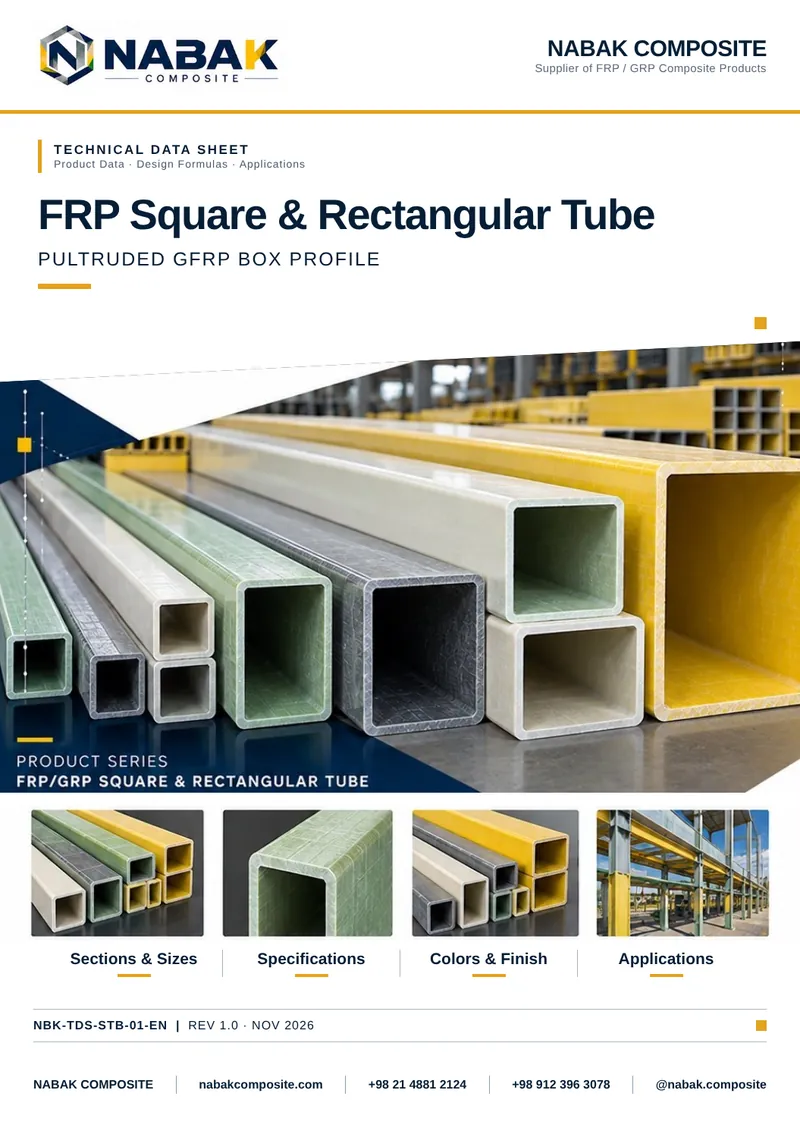
Cover of the NABAK COMPOSITE FRP tube technical data sheet – FRP / GRP Square & Rectangular Tube, code NBK-TDS-STB-01-EN
FRP / GFRP Square & Rectangular Tube — Technical Data SheetIntroduction, structure and benefits | Page 1 of 5

NABAK COMPOSITE FRP tube (FRP / GRP Square & Rectangular Tube) is a hollow square or rectangular pultruded GFRP profile. A lightweight structural shape with a closed section and high torsional stiffness, it does not rust, is electrically and thermally insulating, needs no painting, and replaces steel, galvanized and aluminium tube in structures and equipment in corrosive environments.

25 – 200 mmTube section size
≥ 240 MPaLongitudinal tensile strength (E23)
≥ 23 GPaLongitudinal modulus of elasticity
6 / 12 mBar length

What is FRP tube (GFRP box profile)?

Composite tube, also known as FRP tube, GFRP tube, fiberglass tube, composite box profile, composite square and rectangular tube and fiberglass square pipe, is made by pultrusion: continuous glass-fibre rovings together with multi-directional mats and fabrics pass through a resin bath, are shaped over a fixed mandrel in a heated die and cured as a hollow profile. A surface veil protects the profile against UV and moisture.

FRP is the general name for fibre-reinforced polymers, and GFRP (or GRP) is FRP made with glass fibre. For the same weight, the closed section of composite tube has far higher torsional stiffness than open profiles (channel, I-beam and angle) and resists lateral-torsional buckling better; FRP tube is therefore the first choice for composite columns, light beams, frames and truss members.

Layered wall structure of composite tube

Surface veilResin-rich layer with polyester fibres for a smooth surface, UV resistance and no fibre blooming.
Transverse matContinuous mat or ±45° fabric providing transverse and shear strength and bolt-bearing resistance.
Longitudinal rovingThe main core of continuous glass fibre along the length; source of the axial and flexural strength and modulus of FRP tube.
Inner mat and veilInner layer that balances the section, prevents warping and protects the inner surface.

Advantages of FRP tube over steel tube

  • Corrosion-resistant: composite tube does not rust in seawater, acid fumes, chlorine or sewage; no galvanizing or painting.
  • Lightweight: GFRP profile density is about 1.85 g/cm³; a 100×100×6 tube weighs only 4.2 kg/m.
  • Electrically and thermally insulating: suited to substations, line maintenance platforms and areas with electric-shock risk.
  • Non-magnetic and radio-transparent: suited to antenna structures, radar and measuring equipment.
  • Easy fabrication: cut with a diamond saw and bolted or bonded; no welding or hot-work permits.
  • Long service life: life-cycle cost far below steel tube in corrosive environments.

Colour, resin and surface of FRP tube

Table 1 — Resin and colour options for composite tube
ResinApprox. service temperatureFeatureRecommended use
Isophthalic polyester≈ 80 °CEconomical, good chemical resistanceGeneral structures, architecture, water and sewage
Vinyl ester≈ 100 °CExcellent chemical and fatigue resistancePetrochemicals, cooling towers, electroplating
Fire-retardant resin≈ 80 °CASTM E84 ≤ 25, self-extinguishingPublic spaces, tunnels, substations

Common colours of composite tube are yellow, grey, green, cream and black, and custom RAL colours are also produced. The pigment is dispersed through the full thickness of the GFRP profile and does not wear or scratch off.

FRP / GFRP Square & Rectangular Tube — Technical Data SheetSize and section property tables | Page 2 of 5

Square composite tube table

Table 2 — Square FRP tube: sizes and section properties (ρ = 1.85 g/cm³)
Size B×B×t (mm)Cross-section area A (mm²)Weight (kg/m)Moment of inertia I (mm⁴)Section modulus W (mm³)Radius of gyration i (mm)Torsion constant J (mm⁴)
25 × 25 × 32640.492.17×10⁴1.74×10³9.13.19×10⁴
38 × 38 × 3.24450.829.07×10⁴4.77×10³14.31.35×10⁵
40 × 40 × 45761.071.26×10⁵6.30×10³14.81.87×10⁵
50 × 50 × 47361.362.62×10⁵1.05×10⁴18.93.89×10⁵
50 × 50 × 610561.953.47×10⁵1.39×10⁴18.15.11×10⁵
60 × 60 × 511002.045.59×10⁵1.86×10⁴22.58.32×10⁵
76 × 76 × 6.417823.301.45×10⁶3.82×10⁴28.52.16×10⁶
100 × 100 × 622564.173.34×10⁶6.67×10⁴38.54.98×10⁶
100 × 100 × 829445.454.18×10⁶8.37×10⁴37.76.23×10⁶

Rectangular composite tube table

Table 3 — Rectangular FRP tube: sizes and section properties about the strong x-axis
Size H×B×t (mm)Cross-section area A (mm²)Weight (kg/m)Ix (mm⁴)Wx (mm³)ix / iy (mm)J (mm⁴)
50 × 25 × 34140.771.26×10⁵5.02×10³17.4 / 9.89.30×10⁴
60 × 40 × 47361.363.45×10⁵1.15×10⁴21.7 / 15.63.53×10⁵
80 × 40 × 48961.667.11×10⁵1.78×10⁴28.2 / 16.05.35×10⁵
100 × 50 × 514002.591.74×10⁶3.47×10⁴35.2 / 20.01.31×10⁶
120 × 60 × 620163.733.60×10⁶6.00×10⁴42.3 / 24.02.71×10⁶
150 × 75 × 625564.737.30×10⁶9.73×10⁴53.4 / 30.65.56×10⁶
200 × 100 × 845448.412.31×10⁷2.31×10⁵71.2 / 40.81.76×10⁷

Section properties are calculated with Formulas 1 to 4 (page 4) for sharp corners; actual rounded corners reduce the values slightly. Sizes are common market sizes of pultruded composite tube; custom sizes are possible with a new die. Tolerances per EN 13706-2.

Square or rectangular? Square composite tube has equal stiffness in both directions and is the better choice for columns, handrail posts and compression members. Rectangular FRP tube, with its long side in the load direction, deflects less for the same weight and suits beams, platform joists and purlins.

Length, tolerances and packing

Table 4 — Typical tolerances of pultruded FRP tube (EN 13706-2)
ParameterTypical toleranceRemarks
Outside section dimensions±0.5 to ±1.0 mmDepending on the size of the composite tube
Wall thickness±10% (minimum ±0.2 mm)Checked on all four sides
Straightness≤ 0.2% of length6 m bar: maximum 12 mm bow
Twist≤ 1° per metreImportant in frames and connections
Bar length6000 mm (+20 / −0)Lengths up to 12 m and cut to size
FRP / GFRP Square & Rectangular Tube — Technical Data SheetEN 13706 properties, comparison and applications | Page 3 of 5

Mechanical properties of composite tube per EN 13706

Table 5 — Minimum properties of EN 13706-3 pultruded profile grades and typical values of FRP tube
PropertyTest methodGrade E23 (minimum)Grade E17 (minimum)Typical value, GFRP tube
Longitudinal tensile modulusEN ISO 527-423 GPa17 GPa23 – 28 GPa
Longitudinal tensile strengthEN ISO 527-4240 MPa170 MPa250 – 350 MPa
Transverse tensile strengthEN ISO 527-450 MPa30 MPa50 – 80 MPa
Longitudinal flexural strengthEN ISO 14125240 MPa170 MPa250 – 350 MPa
Transverse flexural strengthEN ISO 14125100 MPa70 MPa100 – 130 MPa
Apparent shear strengthEN ISO 1413025 MPa15 MPa25 – 35 MPa
Pin-bearing strength (longitudinal / transverse)EN 13706 Annex150 / 70 MPa90 / 50 MPa180 – 220 / 90 – 120 MPa
In-plane shear modulus G———3 – 4 GPa
Density / Barcol hardnessISO 1183 / EN 59——1.8 – 1.9 g/cm³ / ≥ 45
Longitudinal coefficient of thermal expansion———8 – 10 ×10⁻⁶ /°C

Grade values are quoted from the common text of EN 13706-3; the last column shows typical ranges of the FRP and GFRP composites industry, not NABAK COMPOSITE’s own laboratory results. NABAK composite tube is designed on the basis of grade E23.

Composite tube compared with steel and aluminium tube

Table 6 — FRP tube vs steel and aluminium tube
FeatureGFRP composite tubeS235 steel tube6063-T6 aluminium tube
Density (g/cm³)1.857.852.7
Strength (MPa)240 – 350 (ultimate)235 (yield)170 (yield)
Modulus of elasticity (GPa)23 – 2821070
Specific strength (strength / density)≈ 130 – 190≈ 30≈ 63
Corrosion in chemical and marine environmentsNoneSevereModerate
Electrical / thermal conductivityInsulating / ≈ 0.3Conductive / ≈ 50Conductive / ≈ 200
Governing design criterionDeflection and bucklingStrengthStrength and deflection

Applications of FRP composite tube

Platforms and walkwaysBeams, columns and bracing of composite grating platforms in corrosive environments
Handrails and guardrailsPosts and rails of FRP handrails and industrial safety guards
Cooling towersInternal columns, beams and bracing of towers in GFRP tube
Substations and power linesInsulating structures, ladders and work platforms near live equipment
Canopies, greenhouses and architectureLight frames for canopies, greenhouses and facades in coloured fiberglass tube
Equipment and machineryFrames, chassis and supports in chemical, food and electroplating industries
FRP / GFRP Square & Rectangular Tube — Technical Data SheetSection formulas and beam design | Page 4 of 5

Section property formulas for composite tube

1. Cross-section area and weight of the tube
A = B H − (B − 2t)(H − 2t) ,   w = ρ A

100×50×5: A = 5000 − 40 × 90 = 1400 mm²; w = 1.85 × 1400 × 10⁻³ ≈ 2.59 kg/m

2. Moment of inertia and section modulus
Ix = B H³ − b h³12 ,   Wx = 2 IxH

b = B − 2t, h = H − 2t. 100×50×5: Ix ≈ 1.74×10⁶ mm⁴, Wx ≈ 3.47×10⁴ mm³

3. Radius of gyration
i = √( IA )

60×60×5: i = √(5.59×10⁵ / 1100) ≈ 22.5 mm; used to calculate column slenderness

4. Torsion constant of a closed section (Bredt)
J = 4 Am² tpm ,   Am = (B − t)(H − t)

pm centreline perimeter. 50×50×4: J = 4 × 2116² × 4 / 184 ≈ 3.89×10⁵ mm⁴

Beam design with FRP tube (bending + shear deflection)

5. Total deflection of a simple beam under uniform load (Timoshenko)
δ = 5 q L⁴384 E I + q L²8 G Aw ≤ L250 ,   Aw = 2 t (H − 2t)
Example — rectangular composite tube 100×50×5, span 2 m, uniform load 1 kN/m, E = 23 GPa, G = 3 GPa: δb = 5 × 1 × 2000⁴ / (384 × 23 000 × 1.74×10⁶) ≈ 5.22 mm Aw = 2 × 5 × 90 = 900 mm² → δs = 1 × 2000² / (8 × 3000 × 900) ≈ 0.19 mm δ = 5.40 mm ≤ L/250 = 8.0 mm ✓ ; σ = qL²/(8Wx) ≈ 14.4 MPa ≪ 240/2.5 = 96 MPa Shear deflection is significant in composites because of the low shear modulus, and its share grows in short spans. In FRP tube, stress is usually far below the allowable value and deflection governs the design.
6. Local buckling of the compression wall of the tube
σcr,local ≈ k · π² E12 (1 − ν²) · ( tb )² ,   k ≈ 4

b clear width of the wall (B − t). For the tubes in this data sheet, with b/t ≤ 20, local buckling lies beyond the material strength and does not govern; thin-walled tubes with b/t above 30 must be checked (simplified relation for an isotropic plate; for greater accuracy use orthotropic pultrusion design rules).

7. Shear stress in the tube webs
τ = VAw ≤ τuFS

Example above: V = qL/2 = 1000 N → τ = 1000 / 900 ≈ 1.1 MPa ≪ 25 / 2.5 = 10 MPa; in short beams with heavy concentrated loads, check web shear and crushing under the load.

FRP / GFRP Square & Rectangular Tube — Technical Data SheetColumns, torsion, connections and fabrication | Page 5 of 5

Column, torsion and connection design of composite tube

8. Overall column buckling (Euler) and slenderness
Pcr = π² E I(K L)² ,   λ = K Li ,   Pa = min(Pcr, σc A)FS
Example — square tube column 60×60×5, length 2.5 m, pinned both ends (K = 1): Pcr = π² × 23 000 × 5.59×10⁵ / 2500² ≈ 20.3 kN ; λ = 2500 / 22.5 ≈ 111 σc A = 240 × 1100 ≈ 264 kN → Euler governs → Pa = 20.3 / 2.5 ≈ 8.1 kN Because of the low modulus, slender composite columns are governed by overall buckling; intermediate bracing or a larger tube (76×76×6.4 with Pcr ≈ 53 kN) multiplies the capacity.
9. Shear stress and angle of twist
τ = T2 Am t ,   θ = T LG J

50×50×4 with T = 100 N·m: τ ≈ 5.9 MPa and θ ≈ 0.086 rad/m ≈ 4.9°/m

10. Bearing capacity of a bolted connection
Pbr = n · d · t · σbrFS

2 M10 bolts in a 5 mm wall, σbr = 150 MPa (E23), FS = 3: Pbr = 2 × 10 × 5 × 150 / 3 = 5.0 kN

11. Minimum bolt distances
e1 ≥ 2d ,   e2 ≥ 1.5d ,   p ≥ 4d

e₁ end distance, e₂ edge distance, p bolt pitch. M10 bolt: e₁ ≥ 20, e₂ ≥ 15, p ≥ 40 mm

12. Thermal expansion of the member
ΔL = α · L · ΔT

6 m tube, α = 9×10⁻⁶, ΔT = 40 °C → ΔL ≈ 2.2 mm; close to steel and compatible with hybrid structures

Fabrication and installation guide for composite tube

  1. Cutting: cut FRP tube with a diamond or carbide circular saw at high speed and low feed pressure to avoid edge delamination.
  2. Drilling: drill with a carbide or diamond bit, hole 1 to 1.5 mm larger than the bolt; support the part underneath.
  3. Sealing: coat cut surfaces and holes of composite tube with compatible resin so fibres are not exposed to moisture.
  4. Connection: use GFRP angles and plates with stainless or FRP bolts and wide washers; fit spacer bushes inside the tube at bolt positions.
  5. Torque: tighten bolts to a controlled torque so the tube wall is not crushed; do not use impact wrenches.
  6. Safety: wear a mask, goggles and gloves when cutting and drilling, and collect fibre dust with extraction.
Request a quote for FRP tube: send section size and thickness, length and number of bars, colour, resin type (iso, vinyl ester, fire-retardant) and application.
Nabak Saze Gostar | nabakcomposite.com | +98 21 4881 2124 | Mobile +98 912 396 3078 | Instagram @nabak.composite

Disclaimer: The information in this data sheet is based on general, typical data of the FRP and GFRP composites industry and the EN 13706 standard, and is intended as guidance only. Examples are for illustration; structural design must be carried out by a qualified engineer. NABAK COMPOSITE reserves the right to change technical specifications without notice.