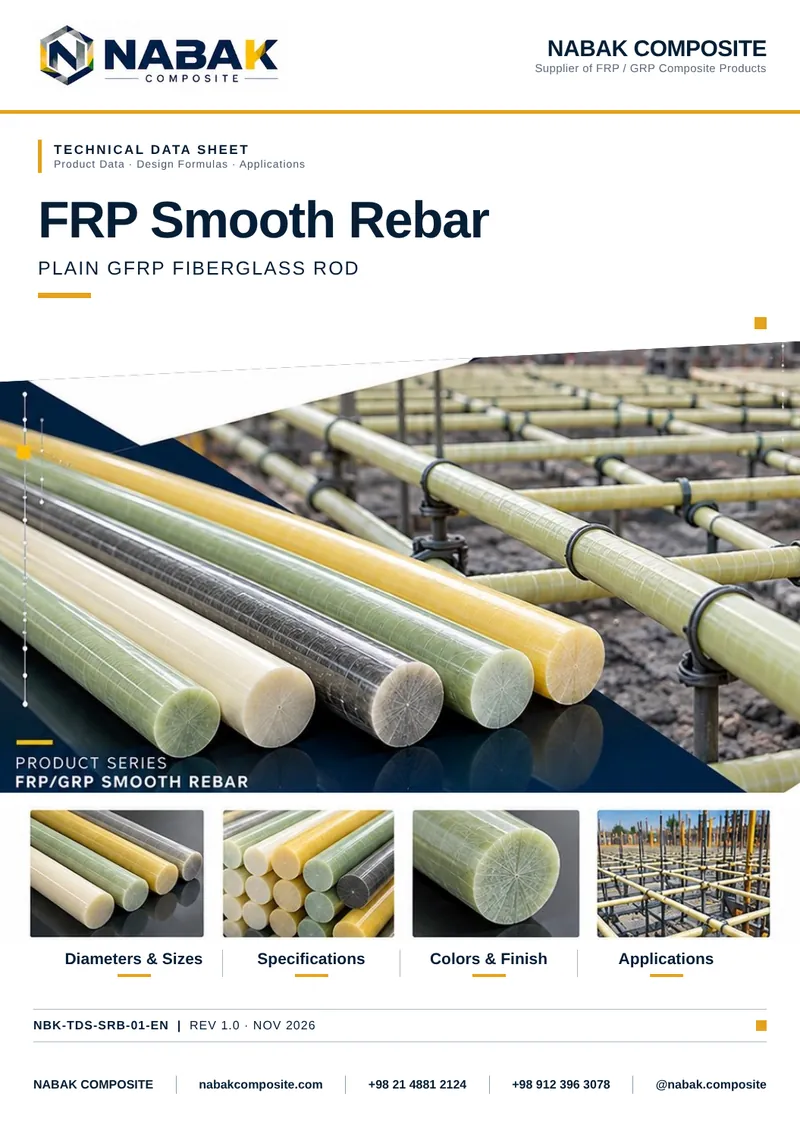
NABAK COMPOSITE FRP smooth rebar (Smooth FRP / GRP Rebar) is a solid pultruded GFRP rod whose continuous glass fibres run fully parallel along its length. It offers about twice the tensile strength of steel rebar at a quarter of its weight, does not rust, is non-magnetic and electrically insulating, and is used for concrete pavement dowels, adhesive anchoring, tension rods and industrial and insulating applications.
What is FRP smooth rebar (plain GFRP bar)?
FRP smooth rebar, also known as composite rebar, FRP rebar, GFRP rebar, fiberglass rebar, non-metallic rebar and plain FRP bar, is made by pultrusion: dozens of continuous glass-fibre rovings pass through a vinyl ester or epoxy resin bath, are shaped to final diameter in a heated round die and cured. The result is a GFRP bar with more than 70% glass fibre by weight, a uniform section and a smooth surface.
FRP is the general name for fibre-reinforced polymers, and GFRP (or GRP) is FRP made with glass fibre. Unlike steel rebar, composite rebar is fully elastic up to failure (no yielding), its modulus is about one quarter of steel, and it does not corrode in alkaline, chloride or humid environments.
Smooth or deformed? The smooth surface of plain composite rebar provides only limited mechanical bond with concrete. Smooth FRP bar is therefore chosen where slip in concrete is desirable (pavement joint dowels), where load is transferred by adhesive or mechanical anchorage, or where no concrete is involved. For structural concrete reinforcement to ACI 440.1R and ASTM D7957, ribbed or sand-coated GFRP rebar is required.
Applications of smooth composite rebar
Benefits of FRP smooth rebar
- No corrosion: composite rebar does not rust in de-icing salt, seawater, sewage or sulphate soils; rust-induced cracking and spalling are eliminated.
- Lightweight: GFRP rebar weighs about one quarter of steel rebar; faster manual handling, loading and installation.
- High tensile strength: the tensile strength of FRP rebar is two to three times the yield stress of ordinary steel rebar.
- Electrically insulating: no induced currents or earth paths; suited to substations, railways and cathodic protection.
- Non-magnetic and radio-transparent: suited to MRI rooms, airports, radar and measuring equipment.
- Easy to cut: fiberglass rebar can be cut by drilling machines and TBMs; used in temporary tunnel walls (soft-eye).