To get a PDF copy, press Print and choose “Save as PDF”.

FRP Flat Sheet Technical Data Sheet — Flat GFRP Composite Sheet by NABAK COMPOSITE

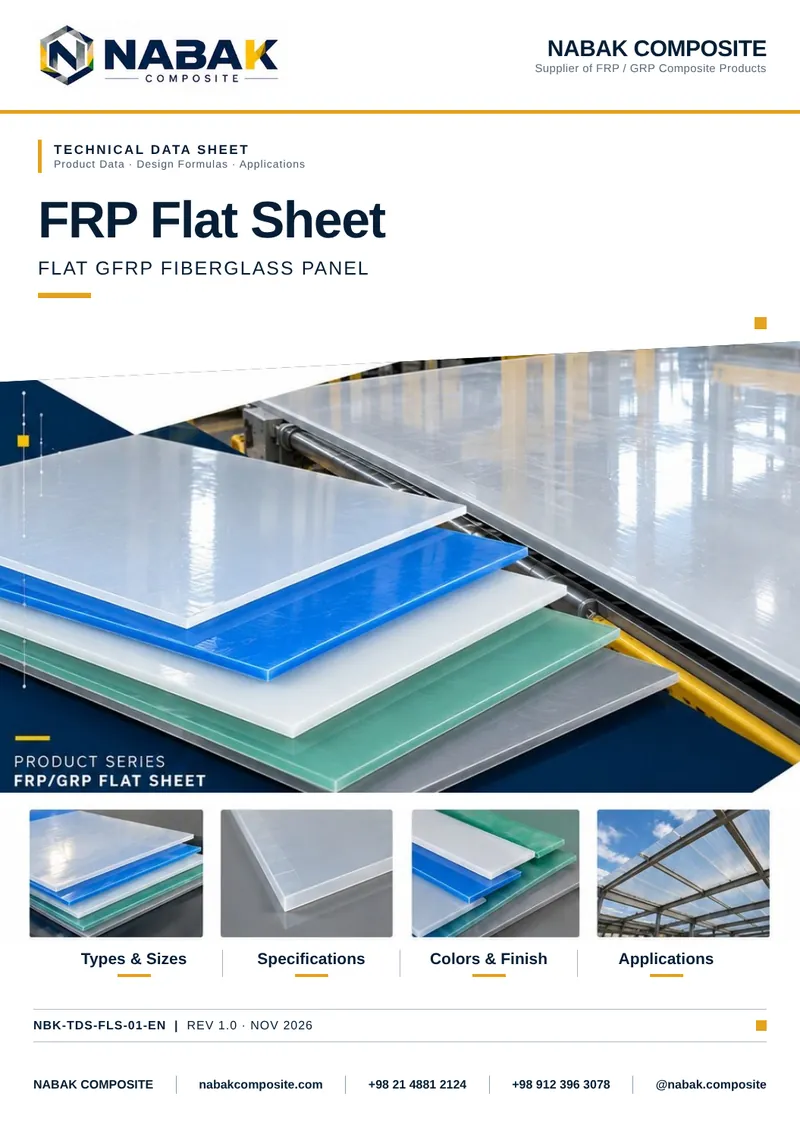
Cover of the NABAK COMPOSITE flat fiberglass sheet technical data sheet – FRP / GRP Flat Sheet, code NBK-TDS-FLS-01-EN
FRP / GFRP Flat Fiberglass Sheet — Technical Data SheetIntroduction, types and benefits | Page 1 of 5

NABAK COMPOSITE flat fiberglass sheet (FRP / GRP Flat Sheet) is a flat GFRP composite sheet made of glass fibre and polyester resin. Lightweight, non-porous, waterproof, corrosion-resistant and impact-resistant, it is supplied clear, opal or coloured, in rolls or cut sheets, and is used for hygienic wall and ceiling cladding, cold rooms, refrigerated truck bodies, skylights and partitions, and lining of industrial equipment.

0.8 – 6 mmSheet thickness
≤ 3000 mmRoll or sheet width
≈ 1.45 kg/m²Weight per millimetre of thickness
≤ 86%Light transmission of clear sheet

What is flat fiberglass sheet (flat FRP sheet)?

Flat fiberglass sheet, also known as flat GRP sheet, FRP flat sheet, flat composite sheet, GFRP sheet, fiberglass sheet in rolls and FRP wall panel, is made by continuous lamination on a flat production line: chopped glass-fibre mat or roving is impregnated with polyester resin between two carrier films, passes through thickness-setting rollers and is cured into a uniform sheet in a heated tunnel. Thicker composite sheets are made by hot pressing or hand lay-up on a polished plate.

FRP is the general name for fibre-reinforced polymers, and GFRP (or GRP) is FRP made with glass fibre. Depending on resin, pigment and surface layer, flat fiberglass sheet can be translucent and light-transmitting or fully opaque and coloured, with a gloss, matt or embossed surface; in every case it has a monolithic, non-porous structure that needs no painting.

NABAK COMPOSITE flat fiberglass sheet types

Clear and opal sheetLight-transmitting flat FRP sheet for skylights, partitions, luminous ceilings and greenhouses
Hygienic wall and ceiling panelMatt or embossed white composite sheet for industrial kitchens, slaughterhouses and food industries
Cold-room and refrigerated sheetGFRP skins for sandwich panels, refrigerated truck bodies and containers
Coloured gelcoat sheetFlat fiberglass sheet with a glossy matching gelcoat for facades, signs and decorative parts
Fire-retardant sheetComposite sheet with fire-retardant resin for public spaces and transport
Thick industrial sheet4 to 6 mm FRP sheet for tank lining, channel covers and light structural parts

Benefits of flat fiberglass sheet

  • Hygienic and non-porous: the surface of flat FRP sheet does not absorb water, grease or dirt and does not support mould or bacteria.
  • Waterproof and moisture-resistant: composite sheet does not swell, rot or delaminate; suited to permanently wet areas and frequent washdown.
  • Impact-resistant: unlike tiles and ceramics, fiberglass sheet does not break or crack.
  • Corrosion- and chemical-resistant: GFRP sheet withstands salt, mild acids, detergents and disinfectants.
  • Lightweight and flexible: thin flat fiberglass sheet is shipped in rolls and can be installed on curved surfaces.
  • Fast, low-cost installation: cut with a cutter or saw, fixed with adhesive and rivets; no tiling, grouting or painting.

Which flat fiberglass sheet? For hygienic walls and ceilings, choose matt or embossed white sheet 1.2 to 2 mm; for refrigerated truck bodies and sandwich-panel skins, gloss sheet 1 to 1.5 mm; for free-spanning skylights and partitions on a frame, clear or opal sheet 2.5 to 4 mm; and for tank lining and industrial parts, 4 to 6 mm composite sheet with chemical-resistant resin.

FRP / GFRP Flat Fiberglass Sheet — Technical Data SheetThickness, sizes, colours and surfaces | Page 2 of 5

Thickness, weight and stiffness table of flat fiberglass sheet

Table 1 — Flat FRP sheet specifications by thickness (ρ = 1.45 g/cm³, E = 7 GPa)
Thickness (mm)Weight (kg/m²)Plate bending stiffness D (N·m)Light transmission (clear sheet)Supply formRecommended use
0.81.160.33≈ 86%RollSuspended ceilings, light lining
1.01.450.64≈ 85%RollSandwich-panel skin, hygienic walls
1.21.741.11≈ 84%Roll / sheetIndustrial kitchen walls, cold rooms
1.52.172.16≈ 82%Roll / sheetRefrigerated truck bodies, containers
2.02.905.13≈ 78%Roll / sheetHigh-traffic walls, framed skylights
2.53.6210.0≈ 75%SheetLight truck floors, partitions
3.04.3517.3≈ 72%SheetPartitions, facades, channel covers
4.05.8041.0≈ 67%SheetTank lining, industrial parts
5.07.2580.1≈ 61%SheetLight floors and covers
6.08.70138.5≈ 57%SheetLight structural panels, electrical insulation

Plate stiffness is calculated with Formula 3 and light transmission with Formula 2 (page 4). Stiffness grows with the cube of thickness; a 2 mm sheet is about 8 times stiffer than a 1 mm sheet.

Sizes and supply forms of flat composite sheet

Table 2 — Common sizes of flat fiberglass sheet
Supply formWidth (mm)Length (mm)Thickness (mm)Thickness tolerance
Roll (coil)1200 / 1500 / 2000 / 2500 / 300030 – 100 m per roll0.8 – 2.0±10%
Standard cut sheet12202440 / 30500.8 – 6.0±10%
Custom sheetUp to 3000To order, up to 12 m1.0 – 6.0±10%

Colours and surface types of flat fiberglass sheet

Table 3 — Colour and surface options for flat FRP sheet
Surface / colourFeatureRecommended use
High glossMirror-like surface, very easy to cleanHygienic walls, refrigerated bodies, facades
MattNo reflection or glareSuspended ceilings, partitions, offices
Embossed (pebble / orange-peel)Hides lines and scratches, higher surface strengthIndustrial kitchens, slaughterhouses, high-traffic corridors
Grit anti-slipQuartz grains in the surface resinTruck floors, ramps, wet surfaces
Clear, opal, blue, greenTranslucent, diffused lightSkylights, light partitions, greenhouses
White, cream, grey and custom coloursMatt and opaque, coloured gelcoatHygienic walls and ceilings, facades, signs

Profiles and accessories for installing flat FRP sheet

Table 4 — Common installation accessories for flat fiberglass sheet
ItemMaterialApplication
H-joint profile (division bar)PVC or matching compositeJoins two sheets at a vertical seam with expansion gap
Inside and outside corner profilesPVC or compositeCovers wall/ceiling corners and columns
End profile (end cap / J)PVC or aluminiumCovers the free sheet edge at doors, windows and floor
Two-piece plastic rivetMatching nylonFixes the composite sheet to the substrate without rust
Installation adhesivePolyurethane or FRP-specific adhesiveFull bonding of the sheet to plaster, concrete, board or metal sheet
Sanitary siliconeAnti-fungal siliconeSealing perimeter joints and the floor junction
FRP / GFRP Flat Fiberglass Sheet — Technical Data SheetProperties, comparison and standards | Page 3 of 5

Mechanical and physical properties of flat composite sheet

Table 5 — Reference properties of flat GFRP fiberglass sheet
PropertyTest standardUnitTypical value
Glass fibre content (by weight)ASTM D2584%25 – 35
DensityASTM D792g/cm³1.4 – 1.5
Tensile strengthASTM D638MPa80 – 120
Flexural strengthASTM D790MPa130 – 200
Flexural modulusASTM D790GPa6 – 8
Poisson’s ratio——≈ 0.3
Izod impact strength (unnotched)ASTM D256kJ/m²40 – 80
Barcol hardnessASTM D2583—35 – 50
Water absorption (24 h)ASTM D570%≤ 0.3
Coefficient of thermal expansionASTM D69610⁻⁶ /°C25 – 35
Thermal conductivity—W/m·K0.18 – 0.25
Dielectric strengthASTM D149kV/mm10 – 15
Flame spread (fire-retardant grade)ASTM E84—Class A to C depending on grade

Flat fiberglass sheet compared with other wall finishes

Table 6 — Flat FRP sheet vs tiles, PVC panel and stainless steel sheet
FeatureFlat fiberglass sheetTiles and ceramicsPVC panelStainless steel sheet
Joints and groutingVery fewMany (dirt traps)LowLow
Impact resistanceExcellentBrittleModerateGood (dents)
Heat stabilityUp to ≈ 90 °CExcellentUp to ≈ 60 °CExcellent
Resistance to salt and detergentsExcellentGoodGoodModerate (chlorine)
Weight (kg/m²)1.5 – 315 – 252 – 46 – 10
Installation cost and speedLow and fastHigh and slowLow and fastHigh

Reference standards for flat fiberglass sheet

Table 7 — Common standards for flat composite sheet
StandardTopicApplication to flat GFRP sheet
ASTM D5319Glass-fibre-reinforced polyester wall and ceiling panelsDimensional, mechanical and surface requirements of hygienic FRP panels
ASTM E84 / EN 13501-1Fire behaviourFlame-spread and smoke class of fiberglass sheet
ASTM D1003Light transmission and hazeLight transmission of clear and opal FRP sheet
ISO 4892 / ASTM G154Weathering and UV ageingColour and surface durability of fiberglass sheet outdoors

Values in Tables 5 and 6 are common reference ranges of the FRP and GFRP composites industry and are not NABAK COMPOSITE’s own laboratory results.

FRP / GFRP Flat Fiberglass Sheet — Technical Data SheetSheet, light and plate formulas | Page 4 of 5

Weight, light and stiffness formulas for flat composite sheet

1. Areal weight of flat fiberglass sheet
w = ρ · t   [kg/m²]

ρ in g/cm³ and t in mm. 1.5 mm sheet: 1.45 × 1.5 ≈ 2.17 kg/m²

2. Light transmission vs thickness (Beer-Lambert)
τ = (1 − R)² · e−μ t

R ≈ 0.04 reflectance per surface, μ ≈ 0.081 /mm for clear FRP sheet. t = 3 mm → τ ≈ 0.92 × e−0.243 ≈ 72%

3. Plate bending stiffness of fiberglass sheet
D = E · t³12 (1 − ν²)

E ≈ 7 GPa, ν ≈ 0.3. 3 mm sheet: D = 7000 × 27 / (12 × 0.91) ≈ 17 300 N·mm = 17.3 N·m

4. Deflection and stress of a simply supported rectangular plate under uniform pressure
wmax = α · q b⁴D ,   σmax = β · q b²t²

b shorter side, a longer side (Kirchhoff-Timoshenko plate theory, ν = 0.3):

Ratio a/b1.01.52.0∞
α0.004060.007720.010130.01302
β0.2870.4870.6100.750
Example — 3 mm flat fiberglass sheet on a 400×400 square frame, wind pressure 0.5 kPa: w = 0.00406 × 0.0005 × 400⁴ / 17 300 ≈ 3.0 mm ≤ b/100 = 4 mm ✓ σ = 0.287 × 0.0005 × 400² / 3² ≈ 2.6 MPa ≪ σu If deflection exceeds about half the thickness, the sheet starts to act as a membrane and the linear formula is conservative.

Maximum support spacing of flat FRP sheet

Table 8 — Maximum square frame size (mm) for deflection b/100 and stress ≤ 40 MPa (linear, conservative method)
Thickness (mm)1.01.52.02.53.04.05.06.0
Pressure 0.5 kPa140220290360440580730880
Pressure 1.0 kPa110170230290340460580690

Thin flat fiberglass sheets (0.8 to 2 mm) for wall and ceiling cladding are bonded to a continuous substrate, and this table does not apply to them. For free-spanning skylights and partitions, choose a thicker sheet or a frame with closer spacing.

5. Thickness required for allowable deflection
treq = ( 12 (1 − ν²) · α · q · b⁴E · wlim )1/3

Light partition with a 600×600 frame, pressure 0.5 kPa and wlim = b/100 = 6 mm: treq ≈ 4.1 mm → 5 mm flat fiberglass sheet, or 4 mm sheet with a frame of at most 580 mm (Table 8)

FRP / GFRP Flat Fiberglass Sheet — Technical Data SheetInstallation formulas, fixing and applications | Page 5 of 5

Installation formulas for flat fiberglass sheet

6. Expansion gap between sheets
g ≥ α · L · ΔT

3050 mm sheet, α = 30×10⁻⁶, ΔT = 30 °C → g ≥ 2.7 mm; 3 mm gap with an H-joint profile

7. Minimum cold bending radius of the sheet
Rmin = t2 εa

Allowable strain εa ≈ 0.5% → Rmin ≈ 100 t. 1.5 mm sheet: 150 mm; 3 mm sheet: 300 mm

8. Sheet length in one roll
L = Mρ · t · W

104 kg roll, t = 1.2 mm, W = 1.2 m: L = 104 / (1.45 × 1.2 × 1.2) ≈ 50 m

9. Installation adhesive consumption
ma = A · c · (1 + s)

c ≈ 0.3 – 0.5 kg/m², s ≈ 0.10 waste. 100 m² wall with c = 0.35: ma ≈ 38.5 kg

10. Number of rivets or screws per sheet
N ≈ Psp + Asf²

1220×2440 sheet, edges every 200 mm and field every 400 mm: 7.32/0.2 + 2.98/0.16 ≈ 37 + 19 = 56

11. Area and number of sheets for a wall
n = ⌈ Awall · (1 + s)Asheet ⌉

80 m² wall, 8% waste, 2.98 m² sheet: n = ⌈86.4 / 2.98⌉ = 30 sheets

Installation guide for flat fiberglass sheet

  1. Substrate preparation: the wall or ceiling surface must be flat, dry, clean and free of dust and grease; level uneven substrates with board or plaster.
  2. Measuring and cutting: cut flat FRP sheet with an industrial cutter, fine-tooth circular saw or sheet shears and sand the edge.
  3. Drilling: drill rivet holes 1 to 2 mm larger than the rivet diameter so the composite sheet can expand freely.
  4. Adhesive: spread the adhesive with a notched trowel on the back of the fiberglass sheet and press the sheet onto the substrate with a roller.
  5. Rivets and profiles: fix the sheet with plastic rivets and cover joints with H, inside-corner and outside-corner profiles.
  6. Sealing and cleaning: seal perimeter joints with sanitary silicone and clean the surface with water and mild detergent.

Applications of flat fiberglass sheet

Hygienic walls and ceilings of industrial kitchens, slaughterhouses, dairy and food plants and laboratories; skins of cold-room sandwich panels and refrigerated truck and container bodies; skylights, light partitions and suspended ceilings; lining of tanks, channels and industrial equipment; facades, signs and decorative parts. In all these applications, NABAK COMPOSITE flat fiberglass sheet and GFRP composite sheet are a lightweight, hygienic and durable replacement for tiles, metal sheet and PVC panels.

Request a quote for flat fiberglass sheet: send thickness, clear or opaque, colour, surface type (gloss, matt, embossed), roll or sheet, dimensions, area and application.
Nabak Saze Gostar | nabakcomposite.com | +98 21 4881 2124 | Mobile +98 912 396 3078 | Instagram @nabak.composite

Disclaimer: The information in this data sheet is based on general, typical data of the FRP and GFRP composites industry and is intended as guidance only. NABAK COMPOSITE reserves the right to change the technical specifications of flat fiberglass sheet without notice.