To get a PDF copy, press Print and choose “Save as PDF”.

FRP Flat Bar Technical Data Sheet — Pultruded GFRP and Fiberglass Flat Strip by NABAK COMPOSITE

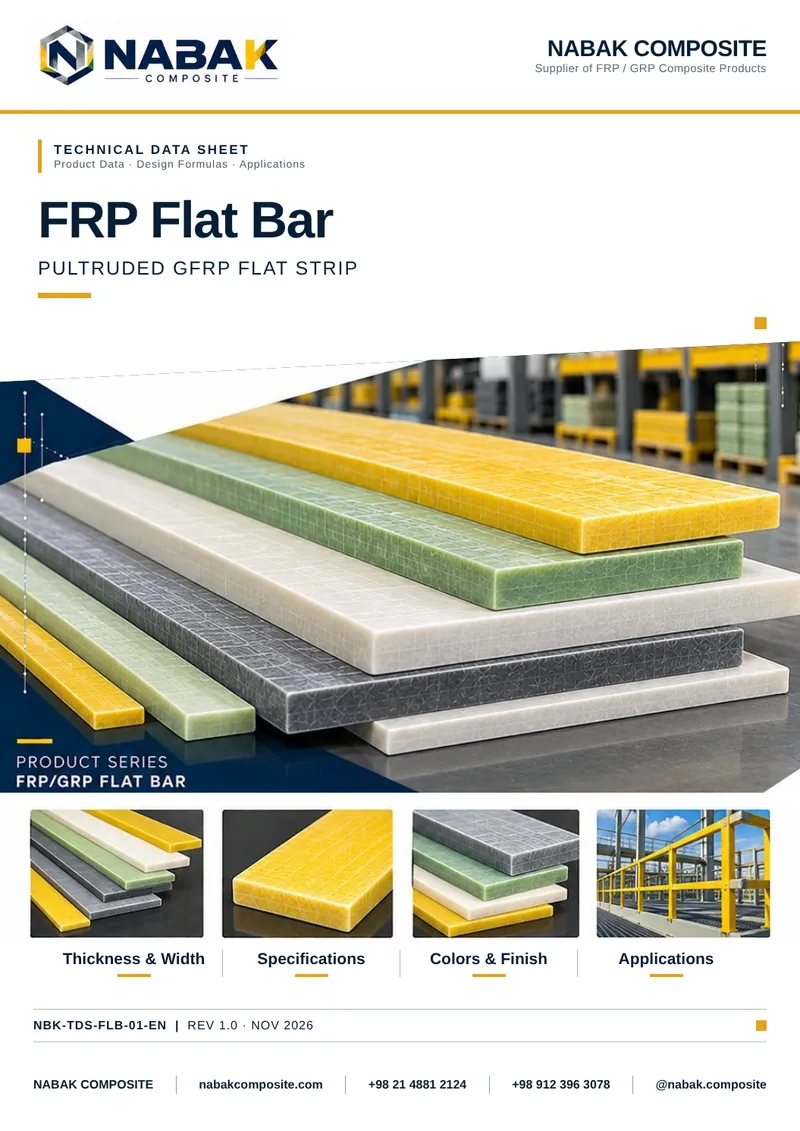
Cover of the NABAK COMPOSITE FRP flat bar technical data sheet – FRP / GRP Flat Bar, code NBK-TDS-FLB-01-EN
FRP / GFRP Flat Bar — Technical Data SheetIntroduction, structure and applications | Page 1 of 5

NABAK COMPOSITE FRP flat bar (FRP / GRP Flat Bar) is a solid pultruded GFRP profile with a rectangular section. Strong in tension, lightweight, rust-free, electrically insulating and maintenance-free (no painting), it replaces steel, galvanized, aluminium and timber flat bar for toe boards, gusset plates, wear strips, cable-tray supports and insulating parts in corrosive and electrical environments.

25 – 200 mmBar width
3 – 12.7 mmBar thickness
≥ 240 MPaLongitudinal tensile strength
≈ 1/4of the weight of an equal steel flat bar

What is FRP flat bar (GFRP strip)?

Composite flat bar, also known as FRP flat bar, GFRP strip, fiberglass flat bar, composite strip profile and narrow composite plate, is made by continuously pulling glass-fibre rovings and surface mats impregnated with resin through a heated rectangular die. Flat bar usually has a higher share of longitudinal fibre than other profiles, so it performs very well in tension and bending along its length and is ideal for tension members and plate parts.

FRP is the general name for fibre-reinforced polymers, and GFRP (or GRP) is FRP made with glass fibre. Flat bar is a simple section with one strong axis (on edge) and one very weak axis (flat); this difference is critical in the design of FRP flat bar and is explained on pages 4 and 5.

Structure of composite flat bar

Longitudinal roving coreContinuous, parallel glass fibres; the main source of tensile strength and stiffness of FRP flat bar.
Transverse matContinuous mat or fabric that raises transverse strength, bolt bearing and resistance to splitting.
Surface veilSmooth, resin-rich surface with UV additives for durability and a uniform finish.
EdgesSharp or rounded edges (to order); rounded edges for toe boards and hand-accessible parts.

Advantages of FRP flat bar over steel flat bar

  • Corrosion-resistant: composite flat bar does not rust in seawater, chlorine, acids or chemical fumes.
  • Electrically and thermally insulating: GFRP strip suits insulating parts of panels, substations and busbar supports.
  • Lightweight: a 100×10 fiberglass flat bar weighs only 1.85 kg/m — about a quarter of steel.
  • High tensile strength: equal to or higher than structural steel along the length.
  • Non-magnetic and non-sparking: suited to explosive atmospheres and sensitive equipment.
  • Easy fabrication: cut and drilled with simple tools; no welding or hot work.

Applications of FRP flat bar

Handrail toe boards100 or 150 mm toe boards for FRP handrails on platforms and walkways
Gusset and splice platesGusset plates and splices for composite beams, columns and bracing
Wear strips and guidesConveyor wear strips, chain guides and sliding-door guides
Cable tray and electricalSupports, clamps and insulating parts of panels and substations
Cooling towersBlades, fill supports and internals resistant to humidity
Edging and fencingEdging, frames, fences and light corrosion-free railings
FRP / GFRP Flat Bar — Technical Data SheetSize table, section properties and supply | Page 2 of 5

Size and section property table of composite flat bar

Table 1 — FRP flat bar: sizes, weight and section properties (ρ = 1.85 g/cm³)
Width × thickness b×t (mm)A (mm²)Weight (kg/m)I strong (on edge) (mm⁴)W strong (mm³)I weak (flat) (mm⁴)W weak (mm³)J (mm⁴)Ultimate tensile force (kN)
25 × 3750.143.91×10³312563820818.0
25 × 6.41600.308.33×10³6675461711.83×10³38.4
38 × 6.42430.452.93×10⁴1.54×10³8302592.97×10³58.4
50 × 52500.465.21×10⁴2.08×10³5212081.95×10³60.0
50 × 6.43200.596.67×10⁴2.67×10³1.09×10³3414.02×10³76.8
50 × 105000.931.04×10⁵4.17×10³4.17×10³8331.46×10⁴120
76 × 6.44860.902.34×10⁵6.16×10³1.66×10³5196.29×10³117
76 × 9.57221.343.48×10⁵9.15×10³5.43×10³1.14×10³2.00×10⁴173
100 × 6.46401.185.33×10⁵1.07×10⁴2.18×10³6838.39×10³154
100 × 1010001.858.33×10⁵1.67×10⁴8.33×10³1.67×10³3.12×10⁴240
150 × 1015002.782.81×10⁶3.75×10⁴1.25×10⁴2.50×10³4.79×10⁴360
200 × 12.725404.708.47×10⁶8.47×10⁴3.41×10⁴5.38×10³1.31×10⁵610

Ultimate tensile force is calculated with the minimum strength of 240 MPa (grade E23); allowable working load = ultimate force ÷ safety factor (2.5 to 3), always checked for holes and connections (Formulas 9 and 10). Section properties from Formulas 1 to 4 (page 4).

Supply form, tolerances and colours of FRP flat bar

Table 2 — Supply specifications of composite flat bar
ParameterValueRemarks
Common widths25, 38, 50, 76, 100, 150, 200 mmOther widths by new die or slitting
Common thicknesses3, 5, 6.4, 9.5, 10, 12.7 mmImperial and metric thicknesses
Bar length6 m (up to 12 m)Cutting and drilling to drawing
Width / thickness tolerance±0.5 mm / ±0.3 mmPer EN 13706-2
ColourYellow, grey, green, cream, blackPigment through the thickness; custom RAL
SurfaceSmooth, matt, grit anti-slipAnti-slip surface for stairs and platform edges
ResinIsophthalic / vinyl ester / fire-retardantVinyl ester for chemical environments; fire-retardant ASTM E84 ≤ 25

Selection guide for composite flat bar

Table 3 — Recommended FRP flat bar for common applications
ApplicationRecommended bar (mm)Note
Composite handrail toe board100 × 6.4 / 150 × 10Bracket connection at each post; rounded edge
Gusset and splice plates for profiles76 × 9.5 / 100 × 10 / 150 × 10Check bolt bearing (Formula 9)
Wear strips and guides25 × 6.4 / 50 × 6.4Countersunk screws or adhesive on a continuous base
Cable-tray clamps and supports38 × 6.4 / 50 × 5Insulating and corrosion-free in electrical installations
Insulating parts of panels and busbars50 × 10 / 76 × 9.5Electrical-grade resin; adequate creepage distance
Cooling-tower blades and supports50 × 5 / 76 × 6.4Vinyl ester resin in hot and chlorinated water
Tension restraints and ties50 × 10 / 100 × 10Net-section and connection capacity (Formulas 8 to 11)
FRP / GFRP Flat Bar — Technical Data SheetMaterial properties, comparison and selection | Page 3 of 5

Mechanical and physical properties of composite flat bar

Table 4 — Reference properties of pultruded GFRP flat bar
PropertyTest methodEN 13706 grade E23 minimumTypical value, FRP flat bar
Longitudinal tensile strengthEN ISO 527-4240 MPa280 – 450 MPa
Longitudinal tensile modulusEN ISO 527-423 GPa23 – 32 GPa
Transverse tensile strengthEN ISO 527-450 MPa50 – 70 MPa
Longitudinal flexural strengthEN ISO 14125240 MPa300 – 450 MPa
Longitudinal compressive strengthEN ISO 14126—240 – 350 MPa
Shear modulus G——3 – 4 GPa
Apparent shear strengthEN ISO 1413025 MPa25 – 40 MPa
Pin-bearing strength, longitudinal / transverseEN 13706150 / 70 MPa180 – 220 / 90 – 120 MPa
DensityISO 1183—1.8 – 2.0 g/cm³
Longitudinal coefficient of thermal expansion——6 – 10 ×10⁻⁶ /°C
Dielectric strength (perpendicular to face)ASTM D149—5 – 10 kV/mm

Values are typical ranges of the FRP and GFRP composites industry and of EN 13706-3, and are not NABAK COMPOSITE’s own laboratory results.

Composite flat bar compared with metal and plastic flat bar

Table 5 — FRP flat bar 100×10 vs steel, aluminium and polyethylene flat bar
FeatureGFRP flat barSteel flat barAluminium flat barUHMW-PE strip
Weight (kg/m)1.857.852.70.94
Tensile strength (MPa)240 – 450360 – 510 (ultimate)200 – 30020 – 40
Modulus (GPa)23 – 32210700.7 – 1
CorrosionNoneSevereModerateNone
Electrically insulatingYesNoNoYes
Dimensional stability and creepExcellentExcellentExcellentHigh creep

GFRP flat bar or CFRP laminate? In the market, “FRP strip” sometimes refers to carbon laminates (CFRP) for strengthening concrete beams and slabs. CFRP laminate has a modulus of 160 to 200 GPa and is designed for structural strengthening. NABAK flat bar is GFRP, intended for lightweight, corrosion-free and insulating structural parts; for concrete strengthening projects, design by a structural engineer and selection of the laminate type are essential.

Selecting flat bar resin by environment

Table 6 — Recommended resin for GFRP flat bar
Service environmentRecommended resinApprox. service temperature
Indoor, general industrial, electricalIsophthalic polyesterUp to ≈ 80 °C
Acids, alkalis, chlorine, seawaterVinyl esterUp to ≈ 100 °C
Public spaces, tunnels, fire requirementsFire-retardant resin (ASTM E84 ≤ 25)Up to ≈ 80 °C
Outdoors with strong sunlightAny resin + UV veil or polyurethane coating—
FRP / GFRP Flat Bar — Technical Data SheetSection, bending and buckling formulas | Page 4 of 5

Section formulas for composite flat bar

1. Cross-section area and weight
A = b · t ,   w = ρ · A

100×10: A = 1000 mm²; w = 1.85 × 1000 × 10⁻³ = 1.85 kg/m

2. Moment of inertia and section modulus, strong axis (on edge)
Is = t b³12 ,   Ws = t b²6

100×6.4: Is ≈ 5.33×10⁵ mm⁴, Ws ≈ 1.07×10⁴ mm³

3. Moment of inertia and section modulus, weak axis (flat)
Iw = b t³12 ,   Ww = b t²6

100×6.4: Iw ≈ 2.18×10³ mm⁴; about 240 times smaller than the strong axis

4. Torsion constant of a thin rectangle
J ≈ b t³3 ( 1 − 0.63 tb )

100×6.4: J ≈ 8 738 × 0.96 ≈ 8.39×10³ mm⁴

Composite flat bar as a beam

5. Lateral-torsional buckling of a bar on edge
Mcr = πLb √( E Iw · G J ) ,   My = σu · Ws
Example — FRP flat bar 100×6.4 on edge, E = 23 GPa, G = 3 GPa: My = 240 × 1.07×10⁴ ≈ 2.56 kN·m (cross-section strength) Lb = 0.5 m: Mcr ≈ 0.22 kN·m ; Lb = 1.0 m: Mcr ≈ 0.11 kN·m Without lateral restraint, a composite flat bar on edge reaches only 4 to 9 percent of its section bending strength and twists quickly. Do not use FRP flat bar as a free beam; for bending choose a composite angle, channel or tube, or a flat bar with continuous restraint (bolted to a post or flange).
6. Compression buckling of flat bar (weak axis)
Pcr = π² E Iw(K L)²

50×10, 600 mm long, pinned both ends: Pcr = π² × 23 000 × 4167 / 600² ≈ 2.6 kN, against a tensile capacity of 120 kN. FRP flat bar is not suitable in compression.

7. Flat bending of the bar (wear strip, toe board)
σ = MWw ,   δ = P L³48 E Iw

150×10 toe board between posts 1.5 m apart under 222 N (OSHA): σ = (222 × 1500/4) / 2500 ≈ 33 MPa ≤ 96 ✓; deflection is relatively large and connecting the toe board to an intermediate post reduces it.

Design rule for composite flat bar: FRP flat bar performs best in tension and as a plate (gusset, splice, strip, cover). In compression, free bending on edge and torsion, the thin rectangular section is very weak and should be restrained continuously or replaced by a more suitable profile.

FRP / GFRP Flat Bar — Technical Data SheetTension, connections, bending and fabrication | Page 5 of 5

Composite flat bar in tension and connections

8. Net-section tensile capacity
An = ( b − n · dh ) · t ,   Ta = σt · AnFS

n number of holes in one cross-section, dh hole diameter. Bar 76×9.5 with one 13 mm hole: An = 63 × 9.5 ≈ 599 mm² → Ta = 240 × 599 / 2.5 ≈ 57.5 kN

9. Bolt bearing capacity
Pbr = n · d · t · σbrFS

2 M12 bolts in a 9.5 mm bar, σbr = 150 MPa, FS = 3: Pbr ≈ 11.4 kN. In FRP flat bar connections, bolt bearing is about one fifth of the section capacity; more bolts or structural adhesive are needed to use the bar’s tensile capacity.

10. Minimum bolt distances in flat bar
e1 ≥ 2d ,   e2 ≥ 1.5d ,   p ≥ 4d ,   b ≥ 3d

M12 bolt: end distance ≥ 24, edge distance ≥ 18 and pitch ≥ 48 mm; minimum bar width for one row of M12 about 36 mm

11. Bonded lap joint (splice)
Pa = τa · b · lo · keFS

τa ≈ 10 MPa (structural epoxy), ke ≈ 0.5 stress-concentration factor. 76 mm bar with 100 mm overlap and FS = 3: Pa ≈ 12.7 kN; combining adhesive and bolts gives a stronger joint.

12. Minimum elastic bending radius
Rmin = E · t2 σa

σa ≈ 0.3 σu = 72 MPa for permanent bending. 6.4 mm bar: Rmin ≈ 23 000 × 6.4 / 144 ≈ 1.0 m; suitable for curved edging and curved blades

Fabrication guide for composite flat bar

  1. Cutting: cut FRP flat bar with a diamond or carbide saw blade at low feed pressure so the edge does not delaminate.
  2. Drilling: use a carbide drill, hole diameter 1 mm larger than the bolt, with a timber backing to prevent breakout at the back of the hole.
  3. Sealing: coat cut edges and holes with compatible resin.
  4. Connection: stainless or FRP bolts with wide washers on both sides; controlled torque.
  5. Load direction: keep tensile load along the length of the bar; limit flat bending and torsion.
  6. Safety: wear a mask, goggles and gloves when cutting; collect fibre dust with extraction.

Is composite flat bar electrically conductive?

No. GFRP flat bar is an electrical insulator. For high-voltage parts, surface creepage distance and surface contamination must also be considered in design.

Are custom widths and thicknesses of FRP flat bar possible?

Yes. Custom sizes of composite flat bar are produced with a new pultrusion die or by slitting from wide sheet and bar.

Request a quote for FRP flat bar: send width and thickness, length and number of bars, colour, surface, resin type and the cutting and drilling drawing.
Nabak Saze Gostar | nabakcomposite.com | +98 21 4881 2124 | Mobile +98 912 396 3078 | Instagram @nabak.composite

Disclaimer: The information in this data sheet is based on general, typical data of the FRP and GFRP composites industry and the EN 13706 standard, and is intended as guidance only. Examples are for illustration; structural design must be carried out by a qualified engineer. NABAK COMPOSITE reserves the right to change technical specifications without notice.