To get a PDF copy, press Print and choose “Save as PDF”.

FRP Corrugated Sheet Technical Data Sheet — GFRP Composite Roofing Sheet and Skylight by NABAK COMPOSITE

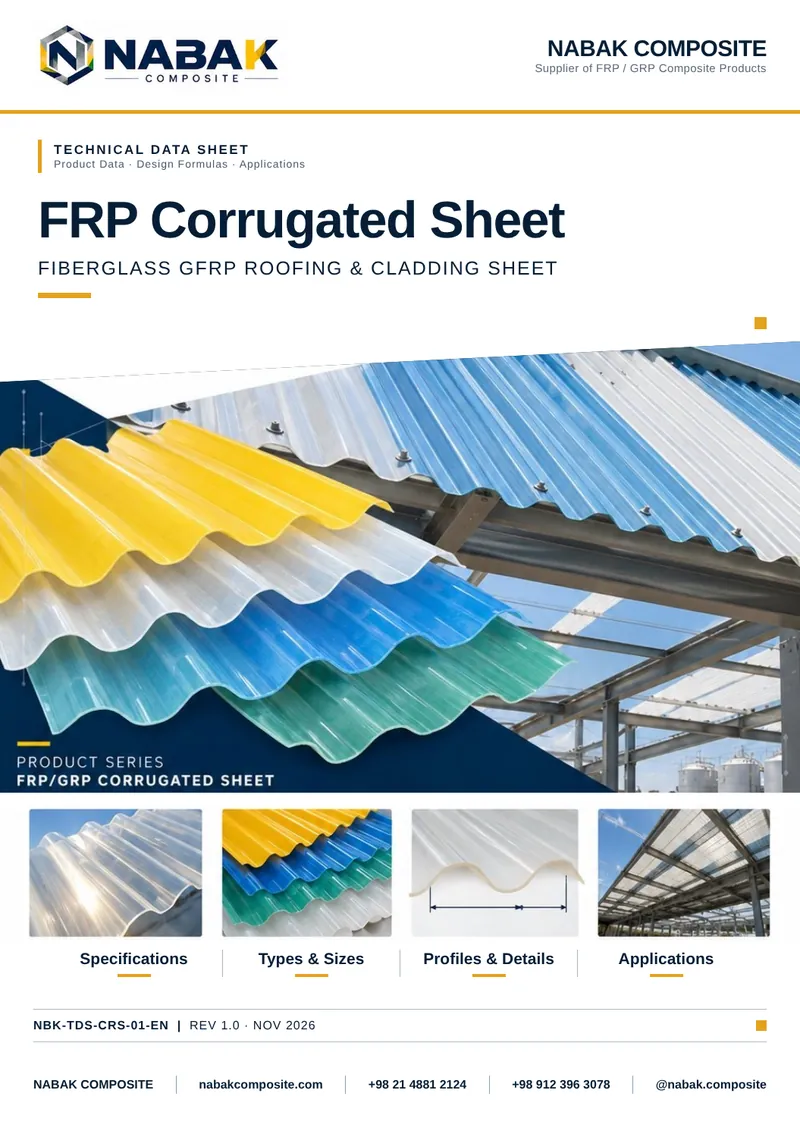
Cover of the NABAK COMPOSITE corrugated fiberglass sheet technical data sheet – FRP / GRP Corrugated Sheet, code NBK-TDS-CRS-01-EN
FRP / GFRP Corrugated Fiberglass Sheet — Technical Data SheetIntroduction, production and benefits | Page 1 of 5

NABAK COMPOSITE corrugated fiberglass sheet (FRP / GRP Corrugated Sheet) is a translucent GFRP composite sheet of glass-fibre mat and polyester resin with a UV-protective layer. Lightweight, corrosion-resistant, shatter-proof and light-diffusing, it is used as rooflights for industrial buildings, greenhouse cladding, canopies, car parks and roofs and walls of industrial and agricultural buildings.

0.8 – 3.0 mmFiberglass sheet thickness
≤ 85%Light transmission of clear sheet
≈ 1.5 – 3.5 kg/m²Weight of corrugated FRP sheet
≤ 12 mSingle-piece sheet length

What is corrugated fiberglass sheet (corrugated FRP sheet)?

Corrugated fiberglass sheet, also known as fiberglass sheet, corrugated FRP sheet, corrugated composite sheet, GFRP sheet, fiberglass rooflight and fiberglass roofing sheet, is made by continuous lamination: chopped glass-fibre mat or continuous roving is impregnated with unsaturated polyester resin on a carrier film, a UV-protective top layer is applied, and the composite sheet is cured into a corrugated or trapezoidal profile as it passes through forming moulds and a heated tunnel.

FRP is the general name for fibre-reinforced polymers, and GFRP (or GRP) is FRP made with glass fibre. In corrugated fiberglass sheet, the refractive indices of the resin and glass fibre are close, so the composite sheet is translucent and delivers light into industrial buildings, greenhouses and warehouses diffused and evenly, without harsh shadows or glare.

Production steps of corrugated fiberglass sheet

  1. Resin preparation: polyester resin is mixed with UV stabiliser, pigment and, where required, fire-retardant additive.
  2. Fibre lay-up: chopped glass-fibre mat or roving is spread evenly over the lower film and resin bed.
  3. Impregnation: the fibres are fully wetted with resin and air bubbles are rolled out.
  4. UV protective film: a protective top layer (gelcoat or UV film) is added to prevent yellowing and fibre blooming.
  5. Profiling and curing: the composite sheet passes through corrugated or trapezoidal moulds and a heated tunnel and is cured.
  6. Cutting and quality control: the FRP sheet is cut to order length and its thickness, weight and light transmission are checked.

Benefits of corrugated fiberglass sheet

  • Diffused natural light: fiberglass sheet brings daylight in without harsh shadows and reduces lighting electricity use.
  • Corrosion- and chemical-resistant: composite sheet does not rust under poultry-house ammonia, fertiliser and acid fumes, salt or humidity.
  • Impact- and hail-resistant: unlike glass, corrugated FRP sheet does not break or shatter.
  • Lightweight and easy to install: fiberglass sheet weighs about 1.5 to 3.5 kg/m²; cut with a diamond disc and fixed with screws and washers.
  • Matches metal sheeting: the trapezoidal profile of GFRP sheet is produced to match common galvanized and pre-painted metal sheets.
  • Dimensional stability: lower thermal expansion than polycarbonate and PVC sheet; no buckling in heat.

When to choose corrugated fiberglass sheet? In industrial buildings, poultry houses, fertiliser and chemical plants, treatment plants and coastal areas with corrosive fumes, ammonia or salt, corrugated FRP sheet outlasts polycarbonate and metal sheet. Wherever diffused, glare-free light matters, such as greenhouses and production halls, translucent composite sheet is the best option.

FRP / GFRP Corrugated Fiberglass Sheet — Technical Data SheetProfiles, sizes, weight and colour | Page 2 of 5

Profiles of corrugated fiberglass sheet

Table 1 — Common profiles of corrugated and trapezoidal FRP sheet
ProfilePitch p (mm)Depth h (mm)Overall width (mm)Cover width (mm)Distributed-load coefficient kApplication
Small corrugation 76/187618860 – 1050760 – 9501.13Greenhouses, canopies, walls
Medium corrugation 130/301303010509201.12Poultry and livestock house roofs
Large corrugation 177/511775111009201.18Rooflights with fibre-cement and corrugated sheets
Trapezoidal 200/352003510401000—Rooflights with trapezoidal galvanized sheet
Trapezoidal 250/402504010501000—Industrial roofs with long purlin spans

The trapezoidal profile of fiberglass sheet is produced to the project’s metal-sheet profile (pitch, depth and number of ribs) to form a matching rooflight next to galvanized or pre-painted sheet. The k factor is calculated with Formula 1 (page 4) for a sinusoidal profile.

Thickness and weight of fiberglass sheet

Table 2 — Areal weight of corrugated FRP sheet by thickness (ρ = 1.45 g/cm³)
Thickness (mm)Flat sheet weight (g/m²)Weight of profile 76/18 (kg/m²)Weight of profile 177/51 (kg/m²)Glass fibre contentRecommended use
0.811601.311.3725 – 30Light greenhouses, walls
1.014501.631.7125 – 30Canopies and car parks
1.217401.962.0525 – 30Standard industrial rooflights
1.521752.452.5727 – 32Industrial roofs, poultry houses
2.029003.273.4227 – 32Chemical environments, heavy snow loads
3.043504.905.1330 – 35Heavy-duty, impact-resistant cladding

In the market, fiberglass sheet is often ordered by “weight per square metre of flat sheet” (e.g. 1800 or 2400 g); the second column is the equivalent of this figure. Composite sheet length is made to order, up to 12 m in one piece.

Colour and light transmission of corrugated fiberglass sheet

Table 3 — Approximate light transmission of 1.2 mm corrugated FRP sheet (ASTM D1003)
Sheet colourVisible light transmissionFeatureRecommended use
Clear / natural75 – 85%Maximum brightness, diffused lightGreenhouses, warehouse and industrial rooflights
Opal50 – 65%Soft light, reduced radiant heatProduction halls, poultry houses, canopies
Yellow50 – 60%Warm, decorative lightCar parks, architectural canopies
Blue40 – 60%Cool light, lower temperaturePools, canopies, facades
Green35 – 55%Reduces direct radiationCourtyard covers, shaded greenhouses, walls

Applications of corrugated fiberglass sheet

Industrial and warehouse rooflightsTrapezoidal FRP sheet matching galvanized sheet profiles
Greenhouses and agricultureClear fiberglass sheet with diffused light for even plant growth
Poultry and livestock housesComposite sheet resistant to ammonia and humidity
Canopies and car parksLightweight coloured fiberglass sheet for car parks and walkways
Chemical and fertiliser industriesFRP sheet roofs and walls in acid and salt fumes
Pools and sports hallsRooflights for pools and sports halls with soft light
FRP / GFRP Corrugated Fiberglass Sheet — Technical Data SheetProperties, comparison and durability | Page 3 of 5

Mechanical and physical properties of corrugated fiberglass sheet

Table 4 — Reference properties of the GFRP composite in corrugated FRP sheet
PropertyTest standardUnitTypical value
Glass fibre content (by weight)ASTM D2584%25 – 35
DensityASTM D792g/cm³1.4 – 1.5
Tensile strengthASTM D638MPa70 – 110
Flexural strengthASTM D790MPa120 – 180
Flexural modulusASTM D790GPa5 – 7
Izod impact strength (unnotched)ASTM D256kJ/m²40 – 70
Barcol hardnessASTM D2583—35 – 45
Coefficient of thermal expansionASTM D69610⁻⁶ /°C25 – 35
Thermal conductivity—W/m·K0.18 – 0.25
Water absorption (24 h)ASTM D570%≤ 0.3
Service temperature range—°C−40 to +90

Fiberglass sheet compared with other rooflight sheets

Table 5 — Corrugated FRP sheet vs polycarbonate, PVC and glass
FeatureGFRP fiberglass sheetPolycarbonateCorrugated PVCGlass
Density (g/cm³)1.4 – 1.51.21.42.5
Coefficient of thermal expansion (10⁻⁶ /°C)25 – 3565 – 7060 – 809
Light diffusionExcellent (no harsh shadows)Low (clear)ModerateLow
Chemical and ammonia resistanceExcellentPoorGoodExcellent
Impact and hailGood, no shatteringExcellentBrittle in coldBrittle
High service temperatureUp to ≈ 90 °CUp to ≈ 120 °CUp to ≈ 60 °CHigh
Fire behaviourFire-retardant grade availableSelf-extinguishingSelf-extinguishingNon-combustible
Table 6 — Durability, fire and reference standards for corrugated fiberglass sheet
TopicReference standardComposite sheet behaviour
Profiled rooflight sheetsEN 1013 / ASTM D3841Classification of FRP sheet by light transmission, mechanical and weathering properties
Weathering and UVISO 4892 / ASTM G154With UV film or gelcoat, little colour change and loss of light transmission
YellowingASTM E313Yellowness index (YI) controlled after ageing
Flame spreadASTM E84 / BS 476Standard grade class C; fire-retardant grade up to class A

Values in Tables 3 to 6 are common reference ranges of the FRP and GFRP composites industry and are not NABAK COMPOSITE’s own laboratory results.

Maintenance: wash corrugated fiberglass sheet once a year with water, mild detergent and a soft brush; do not use solvents, abrasives or high-pressure jets. Keeping the UV-protective layer intact holds the light transmission of the composite sheet stable for years and prevents glass-fibre blooming.

FRP / GFRP Corrugated Fiberglass Sheet — Technical Data SheetProfile and purlin-spacing formulas | Page 4 of 5

Profile and material formulas for composite sheet

1. Developed-length factor of a corrugated (sinusoidal) profile
y = h2 sin( 2πxp ) ,   k = 1p ∫0p √( 1 + (dy/dx)² ) dx

k is the ratio of required flat-sheet length to profiled length. 76/18 → k ≈ 1.13; 177/51 → k ≈ 1.18. That is, 1.13 to 1.18 m of flat sheet is used for each 1 m of profiled width.

2. Areal weight of corrugated FRP sheet
w = ρ · t · k   [kg/m²]

ρ in g/cm³ and t in mm. 76/18 with t = 1.2: 1.45 × 1.2 × 1.13 ≈ 1.96 kg/m²

3. Composite density from fibre weight fraction
ρc = 1Wf/ρf + (1 − Wf)/ρm

Wf = 0.28, ρf = 2.55, ρm = 1.20: ρc ≈ 1.41 g/cm³; fillers raise it to ≈ 1.45.

4. Moment of inertia of corrugated sheet per metre width
Iw ≈ t · h² · k8 × 1000

177/51 with t = 1.5: 1.5 × 51² × 1.18 / 8 × 1000 ≈ 5.76×10⁵ mm⁴/m. Stiffness increases with the square of corrugation depth.

5. Deflection and stress of the sheet between two purlins
δ = 5 q L⁴384 E Iw ≤ L150 ,   σ = q L² h16 Iw

q snow or wind load (N/mm per metre width), E ≈ 6 GPa, σ ≤ σu/3

Purlin spacing table for corrugated fiberglass sheet

Table 7 — Maximum purlin spacing (mm) on two supports for deflection limit L/150 and allowable stress σu/3
Profile / thicknessLoad 0.75 kPaLoad 1.0 kPaLoad 1.5 kPa
76/18 — 1.0 mm570510450
76/18 — 1.5 mm650590510
130/30 — 1.2 mm850770670
130/30 — 2.0 mm1010910800
177/51 — 1.2 mm12301120980
177/51 — 1.5 mm133012001050
177/51 — 2.0 mm146013301160

Calculated with Formulas 4 and 5, E = 6 GPa and σu = 130 MPa. A sheet continuous over three or more purlins may span about 10 to 20 percent further. For trapezoidal sheet, use the purlin spacing of the matching metal sheet and choose fiberglass sheet ≥ 1.2 mm thick. The table is a calculation example.

Snow and hail loads: in snowy regions, select fiberglass sheet purlin spacing from the 1.5 kPa column of Table 7 according to the code snow load (Iranian National Building Regulations, Part 6). Corrugated FRP sheet 1.5 mm thick and above withstands ordinary hail without puncturing or shattering.

FRP / GFRP Corrugated Fiberglass Sheet — Technical Data SheetDaylighting, installation details and applications | Page 5 of 5

Daylighting, expansion and installation formulas

6. Interior illuminance with fiberglass rooflights
Ein ≈ Eout · τ · AsAf · η

Overcast sky Eout ≈ 10 000 lux, τ = 0.75, rooflight-to-floor ratio 10%, η ≈ 0.6 → Ein ≈ 450 lux; sufficient for warehouses and production halls.

7. Thermal expansion and screw-hole diameter
ΔL = α L ΔT ,   dh ≥ ds + ΔL2

4 m sheet, α = 30×10⁻⁶, ΔT = 60 °C → ΔL = 7.2 mm; 6.3 mm screw → hole ≥ 10 mm (sheet fixed at mid-length).

8. Wind uplift force per screw
F = Cp · ½ρ V² · sp · sf

V = 31 m/s (q ≈ 0.59 kPa), Cp = 1.5, purlins at 1.2 m, screws every 354 mm: F ≈ 0.38 kN; Ø19 metal-EPDM washers are mandatory.

9. Minimum roof pitch and rise
Δh = L · tan θ ,   θ ≥ 5° – 10°

8 m roof at 7° pitch: Δh = 8000 × tan7° ≈ 982 mm. Pitches below 5° are not recommended with corrugated fiberglass sheet.

10. Number of sheets across the roof
n = ⌈ B − wlapweff ⌉

Width 20 m, sheet 177/51 with 920 cover width and 180 mm side lap: n = ⌈(20000 − 180)/920⌉ = 22 sheets

11. Required rooflight area
As = Ereq · AfEout · τ · η

1000 m² building for 300 lux: As = 300 × 1000 / (10 000 × 0.75 × 0.6) ≈ 67 m² (about 7% of the roof)

Installation guide for corrugated fiberglass sheet

  1. Laying direction: start from the bottom of the slope and against the prevailing wind; the UV-protected face must face the sun.
  2. Laps: side lap 1.5 corrugations (small profile) or 1 corrugation (large profile), end lap 150 to 200 mm.
  3. Drilling: drill holes on the crown of the corrugation at the diameter from Formula 7; never fix in the valley.
  4. Screws and washers: self-drilling screws with metal-EPDM washers and caps; tighten until the washer is compressed but the sheet is not distorted.
  5. Sealing tape: fit butyl tape at laps and profiled foam fillers at the edges.
  6. Safety: do not walk on fiberglass sheet; use crawling boards across the purlins and cut the sheet with a diamond disc.

Does fiberglass sheet turn yellow?

Corrugated fiberglass sheet without a UV-protective layer gradually yellows and dulls; NABAK COMPOSITE sheets are made with gelcoat or UV film so that their light transmission and colour remain stable.

Can FRP sheet be curved?

Corrugated fiberglass sheet can be curved along the corrugations to a radius of about 3 to 5 m for canopies and tunnel greenhouses; bending across the corrugations is not recommended.

Request a quote for corrugated fiberglass sheet: send the profile (or the project’s metal-sheet profile), thickness or weight per square metre, colour, length and number of sheets, fire-retardant grade and service environment.
Nabak Saze Gostar | nabakcomposite.com | +98 21 4881 2124 | Mobile +98 912 396 3078 | Instagram @nabak.composite

Disclaimer: The information in this data sheet is based on general, typical data of the FRP and GFRP composites industry and is intended as guidance only. NABAK COMPOSITE reserves the right to change the technical specifications of corrugated fiberglass sheet without notice.