To get a PDF copy, press Print and choose “Save as PDF”.

FRP Composite Wire Rod Technical Data Sheet — Coiled GFRP and Fiberglass Rod by NABAK COMPOSITE

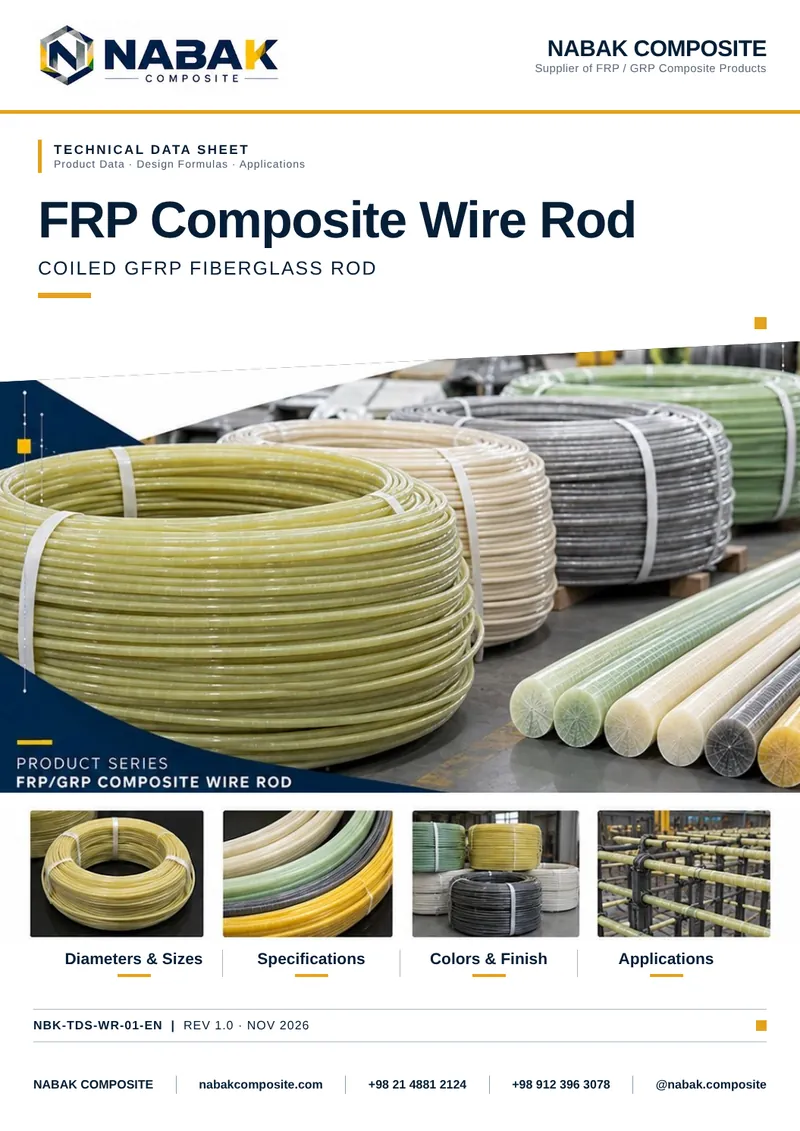
Cover of the NABAK COMPOSITE FRP composite wire rod technical data sheet – FRP / GRP Composite Wire Rod, code NBK-TDS-WR-01-EN
FRP / GFRP Composite Wire Rod — Technical Data SheetIntroduction, types and benefits | Page 1 of 5

NABAK COMPOSITE FRP composite wire rod (FRP / GRP Composite Wire Rod) is a thin, flexible pultruded GFRP rod supplied in long coils. With tensile strength above 1000 MPa, no rust, electrical and thermal insulation and about one quarter of the weight of steel wire, it replaces galvanized and steel wire in wall ties, vineyards, fencing, mesh and cable strength members.

Ø 2 – 10 mmComposite wire rod diameters
1000 – 1300 MPaTensile strength
≈ 0.4 W/m·KThermal conductivity (steel ≈ 50)
≤ 3000 mRod length per coil

What is FRP composite wire rod (GFRP rod)?

Composite wire rod, also known as FRP rod, GFRP wire rod, fiberglass rod, coiled composite rebar, composite wire and non-metallic wire, is made by continuous pultrusion of glass-fibre rovings in vinyl ester or epoxy resin. It differs from composite rebar in its small diameter and flexibility: after curing, GFRP rod is wound onto large-diameter drums or coils without breaking the fibres and is cut to any length on site.

FRP is the general name for fibre-reinforced polymers, and GFRP (or GRP) is FRP made with glass fibre. In fiberglass rod, continuous parallel glass fibres make up more than 75% of the weight; composite rod is therefore very strong in tension, while its thermal and electrical conductivity is hundreds of times lower than steel wire.

NABAK COMPOSITE wire rod types

Smooth rodSmooth-surface GFRP rod for vineyards, fencing, plant stakes and cable strength members
Sand-coated rodRough-surface composite rod for better bond in mortar, plaster and concrete
Thin ribbed rodFRP rod with a helical rib for wall ties and bed-joint reinforcement of masonry
Optical-fibre strength memberPrecise, uniform fiberglass rod for the core of optical-fibre and telecom cables
Coloured rodYellow, green, natural and black composite rod for identification and visible uses
Insulating rodGFRP rod with epoxy resin for electrical parts and thermal insulation

Advantages of FRP rod over steel wire

  • Rust-free: composite rod does not rust in soil, fertiliser, mortar, saltwater or humid air and leaves no rust stains on facades.
  • Near-zero thermal bridging: GFRP rod conducts heat at about one hundredth of steel; ideal for ties in insulated cavity walls.
  • Electrically insulating and non-magnetic: no electric-shock risk in fences and vineyards; no interference with telecom cables.
  • Lightweight: fiberglass rod weighs about 27% of steel wire of the same diameter; far more metres per coil.
  • Resilient, no permanent set: FRP rod springs back straight after bending and does not kink or twist like steel wire.
  • High tensile strength: Ø4 composite rod has an ultimate tensile force of about 15 kN — more than twice ordinary steel wire.

Composite wire rod or composite rebar? FRP rod is 2 to 10 mm in diameter, coiled and flexible, and is used for anchoring, tying, tension and light reinforcement. Structural reinforcement of concrete beams, slabs and walls requires deformed composite rebar designed to ACI 440; its data sheet is available separately.

FRP / GFRP Composite Wire Rod — Technical Data SheetDiameters, coils, colours and surfaces | Page 2 of 5

Diameter and specification table of composite wire rod

Table 1 — GFRP rod specifications by diameter (ρ = 2.1 g/cm³, E = 50 GPa)
Diameter (mm)Cross-section area (mm²)Weight (g/m)Length per 100 kg coil (m)Tensile strength (MPa)Ultimate tensile force (kN)Axial stiffness EA (kN)Minimum coil diameter (mm)
23.146.615 16013004.1157270
37.0714.86 74012508.8353400
412.5726.43 790120015.1628535
519.6341.22 425115022.6982670
628.2759.41 685110031.11414800
738.4880.81 240108041.61924935
850.27105.6945105052.825131070
1078.54164.9605100078.539271335

Values are calculated with the formulas on page 4; minimum coil diameter is based on an allowable storage strain of 0.75%. The tensile strength of composite rod is higher in small diameters because the fibres share the load more uniformly. Values are typical market ranges; the guaranteed value of each order is determined by tensile testing.

Packing and supply forms of GFRP rod

Table 2 — Supply forms of composite wire rod
Supply formDiameter (mm)Weight or lengthCoil inside diameter (mm)Remarks
Drum2 – 32000 – 10000 m≥ 400Optical-fibre cable strength member; even pay-off on the production line
Small coil3 – 650 / 100 / 200 m≥ 800Wall ties, gardens and vineyards, retail use
Industrial coil4 – 1050 – 100 kg1200 – 1500Strapped and palletised for projects
Cut lengths2 – 100.2 to 6 m—Ready-made wall ties, plant stakes and fence posts

Colours and surfaces of fiberglass rod

Table 3 — Colour, surface and resin options
OptionSpecificationRecommended use
Natural cream and light greenVinyl ester resin, unpigmentedWall ties, mesh, industrial use
Yellow and greenPigment through the section + UV stabiliserVineyards, gardens, fencing and outdoor uses
BlackCarbon pigment with high UV stabilityElectric fencing, long-term use in sunlight
Smooth glossPultruded, uncoatedCable strength member, vineyards, stakes
Sand-coated or helical ribRoughness and mechanical interlockMortar, plaster, lightweight concrete and masonry

Diameter selection guide for composite rod

Table 4 — Recommended GFRP rod diameter by application
ApplicationRecommended diameter (mm)SurfaceNote
Optical-fibre cable strength member2 – 3 (smaller to order)Precision smoothDiameter tolerance ±0.05 mm and full uniformity
Wall ties and brick facades4 – 6Sand-coated or ribbedEmbedment ≥ 50 mm in each leaf
Plaster, mortar and lightweight-concrete mesh3 – 5Sand-coatedMesh spacing 50 to 200 mm
Vineyard and orchard trellis3 – 5Smooth, coloured, UV-resistantReplaces galvanized wire gauge 12 to 14
Fencing and electric fencing4 – 8Smooth black or yellowInherently insulating; no insulators needed
Small greenhouse hoops and stakes6 – 10SmoothHoop radius ≥ 100 d
FRP / GFRP Composite Wire Rod — Technical Data SheetProperties, comparison and applications | Page 3 of 5

Mechanical, physical and electrical properties of composite rod

Table 5 — Reference properties of pultruded GFRP rod
PropertyTest methodUnitTypical value
Glass fibre content (by weight)ASTM D2584%75 – 83
DensityASTM D792g/cm³2.05 – 2.15
Tensile strengthASTM D3916MPa1000 – 1300
Tensile modulus of elasticityASTM D3916GPa48 – 55
Ultimate strainASTM D3916%2.2 – 2.6
Flexural strengthASTM D4476MPa1100 – 1400
Water absorption (24 h)ASTM D570%≤ 0.1
Longitudinal coefficient of thermal expansionASTM E83110⁻⁶ /°C5 – 7
Thermal conductivity—W/m·K0.3 – 0.5
Volume resistivityASTM D257Ω·cm≥ 10¹⁴
Continuous service temperature—°C−40 to +80 (epoxy up to +120)

ASTM D3916 and D4476 are the common tensile and flexural test methods for pultruded rods. Values are reference ranges of the FRP and GFRP composites industry and are not NABAK COMPOSITE’s own laboratory results.

Composite rod compared with metal wires

Table 6 — GFRP rod vs galvanized wire, stainless wire and aramid rod
FeatureFRP rodGalvanized wireStainless wireAramid rod
Density (g/cm³)2.17.858.01.35
Tensile strength (MPa)1000 – 1300400 – 550600 – 9001800 – 2400
Modulus (GPa)5020019060 – 120
Thermal conductivity (W/m·K)0.450160.04
Corrosion in mortar and soilNoneOnce the zinc is goneLowNone
Electrical conductivityInsulatingConductiveConductiveInsulating
PriceModerateLowHighVery high

Applications of FRP composite rod

Wall tiesConnect the two leaves of cavity walls and brick facades without thermal bridging or rust
Vineyards and orchardsTrellis wire for grapes, kiwi and fruit trees; no rust in soil or fertiliser
Fencing and electric fencingInsulating fence wire and posts for livestock and sites
Optical-fibre cableNon-metallic, lightweight central FRP strength member
Plaster, mortar and lightweight-concrete meshGFRP rod mesh to control cracking with no risk of rust
Greenhouses and plant stakesHoops for low tunnels and plant stakes made of fiberglass rod
FRP / GFRP Composite Wire Rod — Technical Data SheetRod and coil formulas | Page 4 of 5

Section, weight and strength formulas for composite rod

1. Cross-section area and weight per metre
A = π d²4 ,   w = ρ · A   [g/m]

Ø6: A ≈ 28.3 mm²; w = 2.1 × 28.3 ≈ 59.4 g/m (steel wire ≈ 222 g/m)

2. Ultimate and allowable tensile force
Tu = fu · A ,   Ta = CE · 0.2 · Tu

Ø4: Tu = 1200 × 12.57 ≈ 15.1 kN. For sustained outdoor load (CE = 0.7, creep limit 0.2): Ta ≈ 2.1 kN

3. Axial stiffness and elongation
K = E · A ,   ΔL = T · LE · A

Ø4 with T = 1 kN over 100 m: ΔL = 1000 × 100 000 / 628 300 ≈ 159 mm

4. Specific strength (strength-to-weight ratio)
Lbr = fuρ · g

Breaking length: GFRP rod ≈ 1200×10⁶ / (2100 × 9.81) ≈ 58 km; galvanized wire ≈ 6.5 km

Coil and bending formulas for FRP rod

5. Minimum coil and drum diameter (allowable bending strain)
Dmin = dεa ,   σb = E · dD

εa ≈ 0.75% for long-term coil storage (about one third of ultimate strain). Ø6: Dmin = 6 / 0.0075 = 800 mm; on a 1200 mm coil: σb = 50 000 × 6 / 1200 = 250 MPa (≈ 23% of tensile strength)

6. Rod length in one coil
L = Mw

100 kg coil of Ø6 rod: L = 100 000 / 59.4 ≈ 1684 m

7. Number of turns in the coil
n = Lπ · Dm ,   Dm = Din + Dout2

Din = 1.2 m, Dout ≈ 1.3 m: n ≈ 1684 / (π × 1.25) ≈ 429 turns

8. Outside coil diameter
Dout = √( Din² + L · d²H · φ )

H coil height, φ ≈ 0.85 packing factor. Ø6, L = 1684 m, Din = 1.2 m, H = 0.3 m: Dout = √(1.44 + 1684 × 3.6×10⁻⁵ / 0.255) ≈ 1.30 m

Why does coil diameter matter? Composite rod is fully elastic; if it is wound or folded tighter than Dmin, the glass fibres on the outer surface break in bending. Always store and uncoil GFRP rod at the inside diameters given in Tables 1 and 2.

FRP / GFRP Composite Wire Rod — Technical Data SheetApplication formulas and user guide | Page 5 of 5

Application formulas for FRP rod

9. Thermal bridging of wall ties (point thermal transmittance)
χ = λ · ALins ,   ΔU = nt · χ
Example — 4 ties Ø4 per square metre of wall with 100 mm insulation: Galvanized steel (λ = 50): ΔU = 4 × 50 × 12.57×10⁻⁶ / 0.1 ≈ 0.025 W/m²K Stainless (λ = 17): ΔU ≈ 0.0085 W/m²K ; GFRP (λ = 0.4): ΔU ≈ 0.0002 W/m²K Wall ties made of composite rod cut the heat loss through ties about 125 times compared with galvanized steel and create practically no thermal bridge.
10. Tension in vineyard wire (sag relation)
T = q · L²8 · f

q distributed load (canes, leaves and fruit), L post spacing, f allowable sag. q = 10 N/m, L = 6 m, f = 0.15 m: T = 300 N; Ø4 rod with Tu ≈ 15 kN

11. Thermal length change of rod outdoors
ΔL = α · L · ΔT

100 m row, α = 6×10⁻⁶, ΔT = 40 °C → ΔL ≈ 24 mm; about half of steel wire, with little need for seasonal re-tensioning

12. Number of wall ties
N = Aw · nt + Poso

nt ≈ 2.5 – 5 ties per m² plus extra ties around openings at so ≈ 300 mm. 100 m² wall with 20 m of opening perimeter: N ≈ 250 + 67 = 317

13. Embedment length in mortar
le = Tdτb · π · d

Sand-coated Ø4 rod, τb ≈ 3 MPa in mortar, Td = 0.5 kN: le ≈ 13 mm → practical minimum 50 mm in each leaf

User guide for composite rod

  1. Uncoiling: unwind the coil on a turntable or by rolling the coil; never pull the rod out from the centre of the coil.
  2. Bend control: do not bend GFRP rod tighter than the minimum diameter in Table 1; sharp bends and knots break the fibres.
  3. Cutting: cut with a thin grinding disc, fibre shears or a saw; smooth the cut end with sandpaper.
  4. Fixing and anchoring: use clips and clamps made for FRP rod in vineyards and fences; knotting the rod is not allowed.
  5. Tensioning: tension the rod with a tensioner to the design force and avoid impact and severe twisting while tensioning.
  6. Safety: wear goggles, gloves and a mask when cutting and always restrain the free end of the coil.
Request a quote for FRP composite rod: send diameter, metres or weight, coil or cut lengths, surface type (smooth, sand-coated, ribbed), colour and application.
Nabak Saze Gostar | nabakcomposite.com | +98 21 4881 2124 | Mobile +98 912 396 3078 | Instagram @nabak.composite

Disclaimer: The information in this data sheet is based on general, typical data of the FRP and GFRP composites industry and is intended as guidance only. NABAK COMPOSITE reserves the right to change the technical specifications of composite rod without notice.