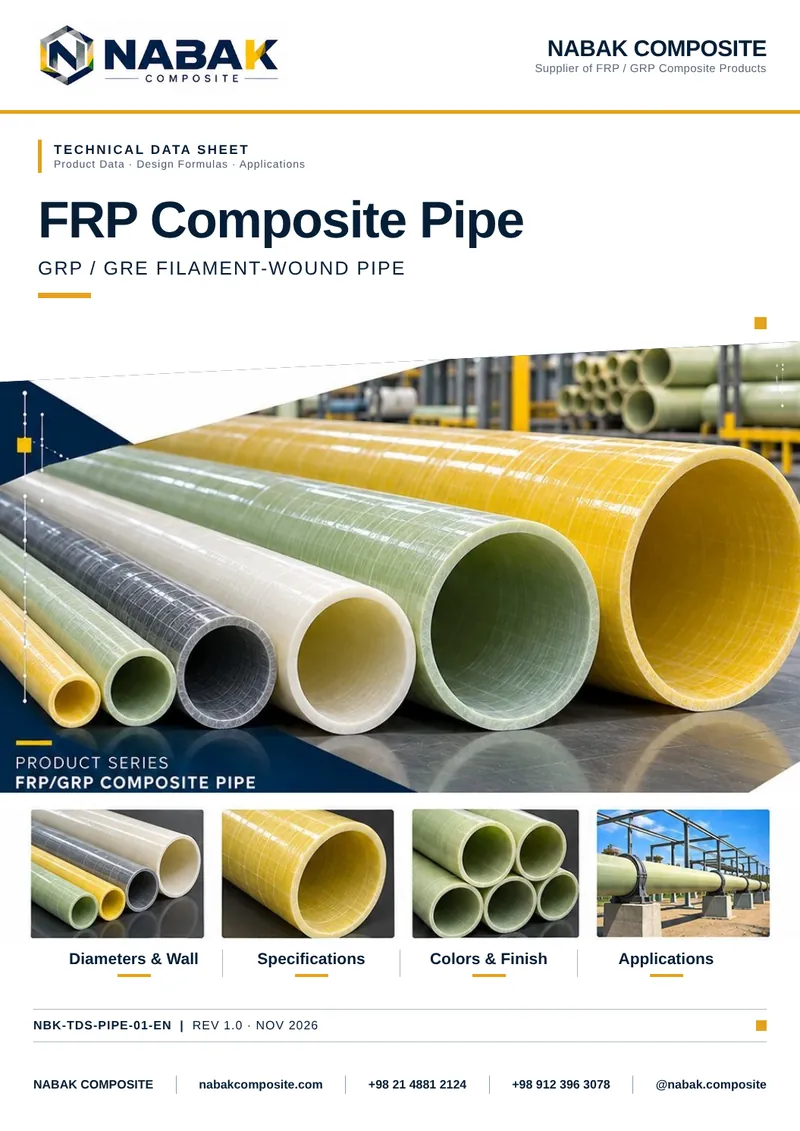
NABAK COMPOSITE FRP composite pipe (FRP / GRP Composite Pipe) is made by filament winding continuous glass fibre with polyester, vinyl ester or epoxy resin. It is lightweight, free of rust and scaling, has a smooth bore and a 50-year design life, and replaces steel, ductile-iron and concrete pipe for water, sewage, seawater, chemicals and industrial fluids.
What is FRP composite pipe (GRP and GRE pipe)?
Composite pipe, also known as FRP pipe, GRP pipe, GRE pipe, GFRP pipe, fiberglass pipe and filament-wound pipe, is made by winding resin-impregnated continuous glass-fibre strands onto a rotating mandrel. The winding angle (typically ±55°) is chosen so that the pipe carries the hoop stress from internal pressure and the axial stress in the optimum ratio. After curing, the FRP pipe is extracted from the mandrel, cut and its ends machined for jointing.
FRP is the general name for fibre-reinforced polymers; GRP (or GFRP) is FRP made with glass fibre and polyester or vinyl ester resin, and GRE is its epoxy version. All these composite pipes share one feature: their walls do not rust, need no cathodic protection or coating, and the smooth bore does not scale or roughen over the service life.
Wall structure of composite pipe
Advantages of FRP pipe over steel and ductile-iron pipe
- No corrosion: composite pipe does not rust in saltwater, sewage, aggressive soil or chemicals; no cathodic protection needed.
- Lightweight: GRP pipe weighs about a quarter of steel pipe and a tenth of concrete pipe; transport and installation without heavy machinery.
- Smooth bore: Hazen-Williams coefficient of 150, constant over the service life; lower head loss and pumping cost.
- Lower water hammer: pressure-wave speed in FRP pipe is about half that of steel; smaller pressure surges.
- Thermally and electrically insulating: no stray currents or electrochemical corrosion.
- 50-year life: design based on 50-year long-term strength and low life-cycle cost.